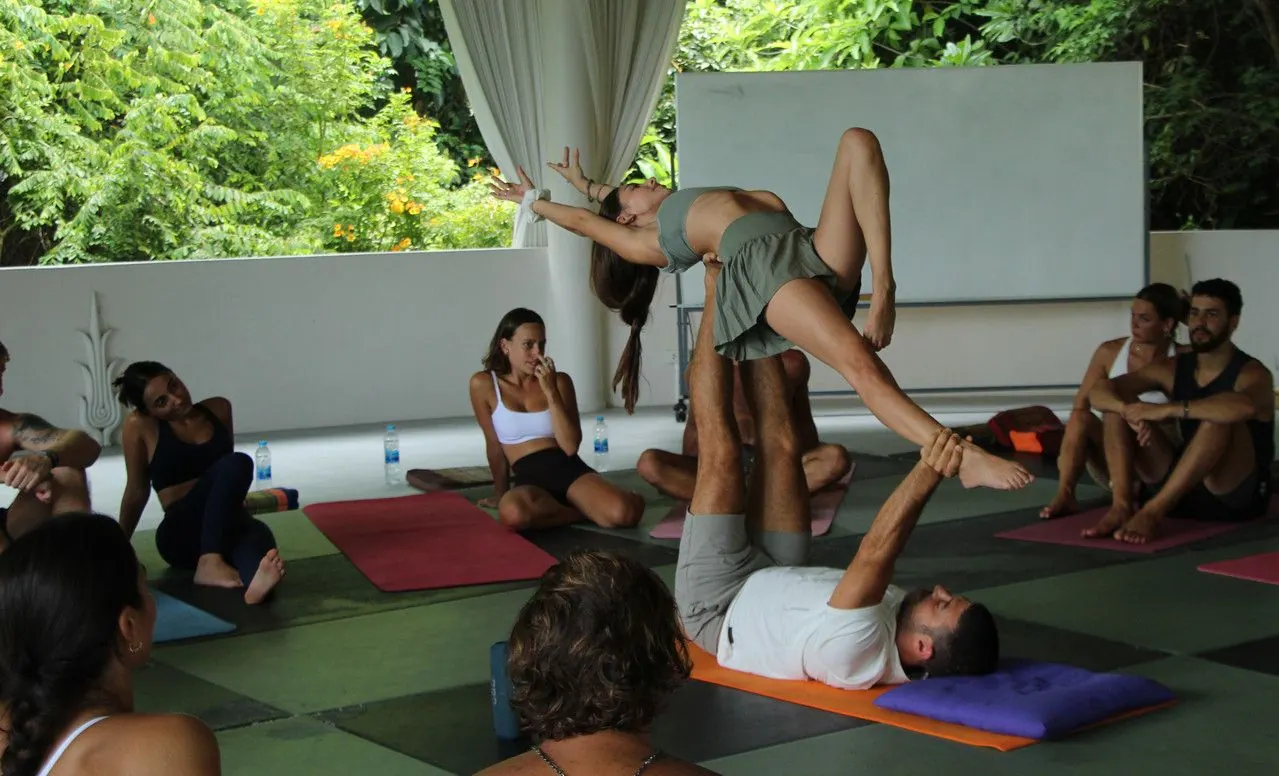
AcroYoga is a movement practice for two that combines yoga, acrobatics and trust work. In practice, one person, the base, lies on their back and "flies" the other, the flyer, on their feet and hands, while a spotter makes sure everyone stays safe. Together they create stable, floating poses such as "front bird" and "chair". The practice doesn't require previous experience, special strength or flexibility: technique, alignment and communication do the work, and the exercises are built gradually from the ground up. AcroYoga suits individuals who come alone (you get paired up in class), couples and groups, and it builds strength, stability, flexibility and, above all, trust between people. In Israel you can practice it in group classes, private lessons and workshops. Our base is at 185 Dizengoff St, Tel Aviv, and the exact location is confirmed when you book.
So what exactly is AcroYoga?
The name combines two words: acro (acrobatics) and yoga. AcroYoga takes the stability, breath and presence of yoga, adds acrobatic elements of lifting and flying, and layers on a third element of touch, trust and communication between two people, inspired by Thai massage.
What makes AcroYoga unique is that it is almost always a partner or group practice, not something you do alone in front of a mirror. You need at least two people, and usually a third who looks after safety. That human connection is exactly what draws so many people to the practice.
The roles: base, flyer and spotter
Every AcroYoga exercise has three roles. Don't let the names scare you. It's simpler than it sounds:
Base: the foundation on the ground
The base is the person lying on their back who gives support from below. They mostly use their legs and hands to hold the flyer in the air. The good news: most of the work relies on bones and structure rather than muscle alone, so you don't need to be especially strong to be a base.
Flyer: the one who flies
The flyer is the person who is lifted and "flies" above the base. The role mostly asks for a stable body, trust and a willingness to let go. It's the role that feels like floating, and it isn't reserved for small or light people. Anyone can fly.
Spotter: the safety keeper
The spotter stands to the side, follows the exercise and is ready to help if anything moves off plan. This is the role that makes AcroYoga safe and lets the flyer and base focus on the practice without worry. Being a spotter is also a great way to learn.
What's the difference between AcroYoga and AcroDance?
This question comes up a lot. AcroYoga focuses on trust, slow and stable lifts, breath and connection between partners, with a calmer, more meditative energy. AcroDance, on the other hand, connects acrobatics to movement, rhythm and music, with continuous flow and a more dynamic feel. Both use the same basic principles of lifting and cooperation, but with a different feeling. Want to go deeper? Read about AcroDance.
The benefits of AcroYoga
Beyond being plain fun, AcroYoga has plenty of real benefits:
- Functional strength: you strengthen your core, legs and posture through natural movement, without weights.
- Flexibility and range of motion: your body opens up gradually as you practice, in a safe way.
- Trust and communication: you learn to trust, to ask for what you need and to communicate without words, skills that are worth gold off the mat too.
- Social connection and community: a partner practice that helps you meet people, breaks the ice and builds a supportive community full of laughter.
- Presence and focus: when someone is balanced on your feet, you are one hundred percent here and now. It's meditation in motion.
- Self-confidence: flying through the air for the first time is a moment that reminds you that you can do more than you thought.
Do I need experience, strength or flexibility?
The short answer: no. This is perhaps the most common misunderstanding about AcroYoga. You don't need an acrobatics background, you don't need to be especially strong, and you definitely don't need to touch your toes. You start from the basics, close to the ground, step by step, and strength, flexibility and confidence arrive along the way. People of every age, body type and fitness level practice AcroYoga. Want to know exactly what a first class looks like? All the details are on the page AcroYoga for beginners. Coming as a couple? We also have an AcroYoga workshop for couples.
How do I get started?
First class
The best way to start is simply to come to a beginner class and try it yourself.
What to wear
Comfortable, fitted sportswear, with no zippers or accessories that get in the way. Bare feet.
Come alone or as a pair
You can come without a partner: you swap partners and practice with everyone.
Tel Aviv
We practice in the heart of Tel Aviv, so it's easy to get to and easy to find a group that suits you.
The simplest way to begin is a short WhatsApp message. We'll tell you when the next beginner class is, what to bring and how it works. No commitment, no pressure. All you need is an open mind and your shoes off.