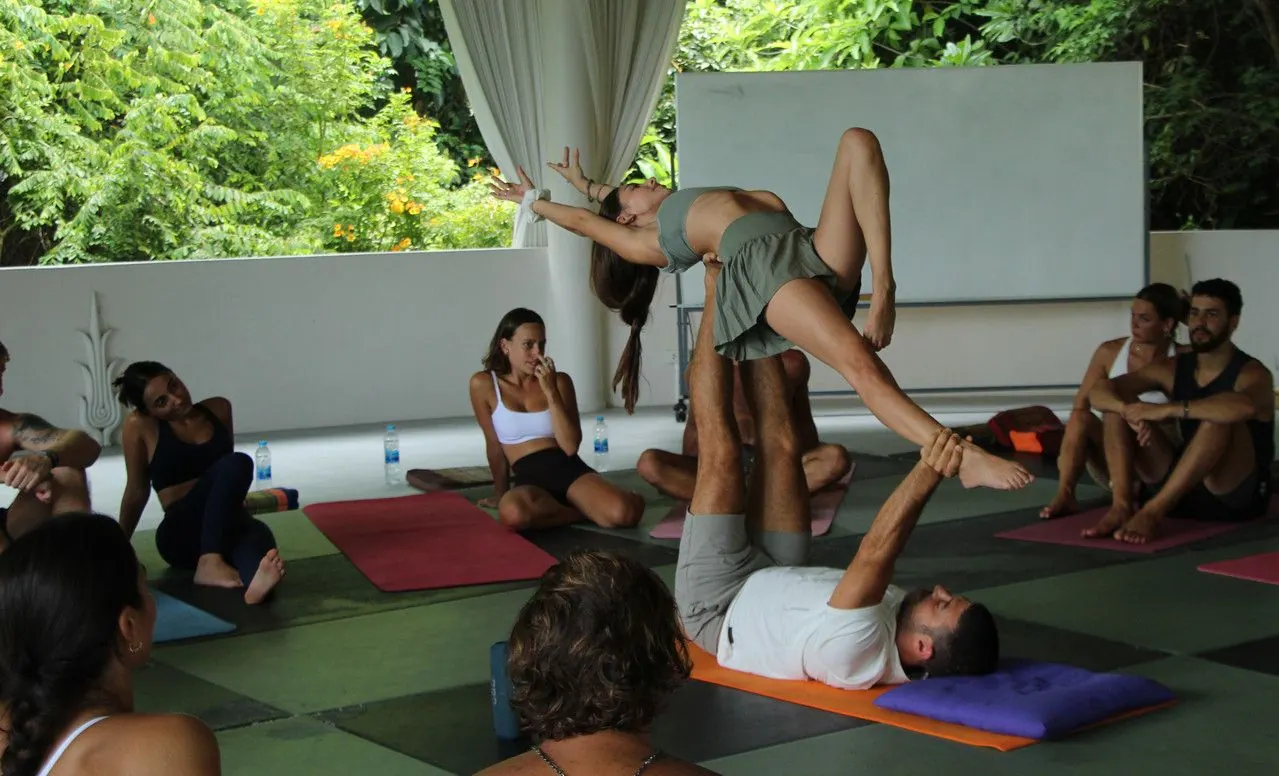
AcroYoga looks impressive, but everyone who has ever flown started with the same 5 basic poses. Every first class at AcroNationTLV starts with them, and within 90 minutes most participants are already flying. In this guide we explain each exercise step by step.
Want to learn these exercises in a structured way?
Before you start: the roles in AcroYoga
Every AcroYoga exercise has three roles:
- Base: the person lying on their back on the floor. Provides the foundation and support with their legs and hands.
- Flyer: the person who goes up into the air and balances above the base.
- Spotter: stands to the side and keeps everyone safe. Catches if someone loses balance.
In a first class we swap roles, so everyone tries everything. You don't need to be strong or flexible to be a base or a flyer.
The 5 exercises
1. Front Plank
Base: lying on their back · Flyer: face down · Level: absolute beginner
The first pose every beginner learns. The base lies on their back, and the flyer leans on the base's feet and straightens into a plank position in the air.
- The base lies on their back with knees bent and feet pointing up.
- The flyer stands facing the base and places their hips on the base's feet.
- The base slowly straightens their legs upward.
- The flyer stretches into a straight plank: one body, from head to toes.
- The spotter stands to the side, hands ready near the flyer's shoulders.
2. Front Bird
Base: lying down · Flyer: face down, arms spread · Level: beginners
The classic "bird": the pose where the flyer soars with arms spread out to the sides. It's the "I'm flying!" feeling that everyone is waiting for.
- Start in a Front Plank (exercise 1).
- The base moves their feet slightly up toward the flyer's hips.
- The flyer relaxes their arms and spreads them out to the sides, like wings.
- The base holds the flyer's hands for stability if needed.
- When it feels stable, the base lets go and the flyer floats free.
3. Throne (the chair)
Base: lying down · Flyer: seated · Level: beginners
The flyer sits on the base's feet, like on a chair in the air. A great pose for photos and for building your first sense of confidence.
- The base lies down with knees bent.
- The flyer sits on the base's feet (feet placed at the flyer's hips and seat).
- The base gradually straightens their legs.
- The flyer sits upright, hands free to pose.
4. Backbird
Base: lying down · Flyer: face up · Level: beginner to intermediate
Like Front Bird, but the flyer is flipped, face to the sky. An amazing pose that gives a feeling of freedom and opens the back.
- The flyer sits on the floor with their back toward the base.
- The base places their feet on the flyer's upper back (the shoulder-blade area).
- The flyer leans back onto the base's feet.
- The base lifts gradually, and the flyer stretches out flat, face up.
- The flyer spreads their arms out to the sides and enjoys it.
5. Folded Leaf
Base: lying down · Flyer: hanging · Level: absolute beginner
AcroYoga's relaxation pose. The flyer hangs over the base's legs like a leaf: a deep stretch for the back and a feeling of complete release.
- Start from Front Bird or Front Plank.
- The flyer relaxes their whole body and folds forward.
- The arms let go toward the floor.
- The head is released: a passive, calm practice.
- The base holds steady, hands on the flyer's shoulders or hands.
What's next?
These 5 exercises are the foundation that everything in AcroYoga grows from, including standing lifts, planned sequences (flows) and AcroDance. Once you've got them, the next class already includes variations, transitions between poses, and a completely different feeling of flow.
The best way to learn them? With an instructor who watches you, corrects you in real time and keeps you safe. That's exactly what happens in our AcroYoga classes in Tel Aviv.
Frequently asked questions
Can you practice AcroYoga at home?
Technically yes, but it isn't recommended without an instructor, especially for beginners. An experienced spotter prevents injuries. Start with a guided class, and once you've learned the technique and the safety habits you can keep practicing on your own.
What if I'm too heavy to go up?
Even weight differences between partners don't necessarily prevent AcroYoga practice. Technique, skeletal alignment and the choice of exercises matter a great deal, so we adapt the practice to the body build and ability of the participants.
After how many classes can I do all 5 exercises?
Most students do all 5 in the very first class. Front Plank and Folded Leaf usually within 10 minutes. Front Bird and Throne within half an hour. Backbird sometimes takes one more class.